
Model Relationships
Market Share/Fuel Choice Policies
Policies designed to modify the fuel mix are aimed at shifting the marginal market share fraction (MMSF) of a particular fuel by device. Consumers choose alternative fuels as the relative costs of each option change or as non-price factors change (such as perceptions of products that could shift due to marketing efforts).
The figure below graphically shows inputs to the fuel choice marginal market share (MMSF) equation. A marginal market share fraction is calculated across fuels for each end use (device) represented in the model. The key inputs to the equation are: marginal cost of fuel use (MCFU), fuel price variance factor (MVF), a marginal market share multiplier/non-price factor (MMSM0), and multiplier on the marginal market share multiplier (MSMM). The key inputs to the marginal cost of fuel use (MCFU) are also shown on the figure consisting of: fuel price (ECFP), device energy efficiency (DEE), device capital cost (DCC), device capital charge rate (DCCR), device operating and maintenance costs (DOMC), and a device grant fraction (DGF) which is a policy variable impacting the operating and maintenance costs.
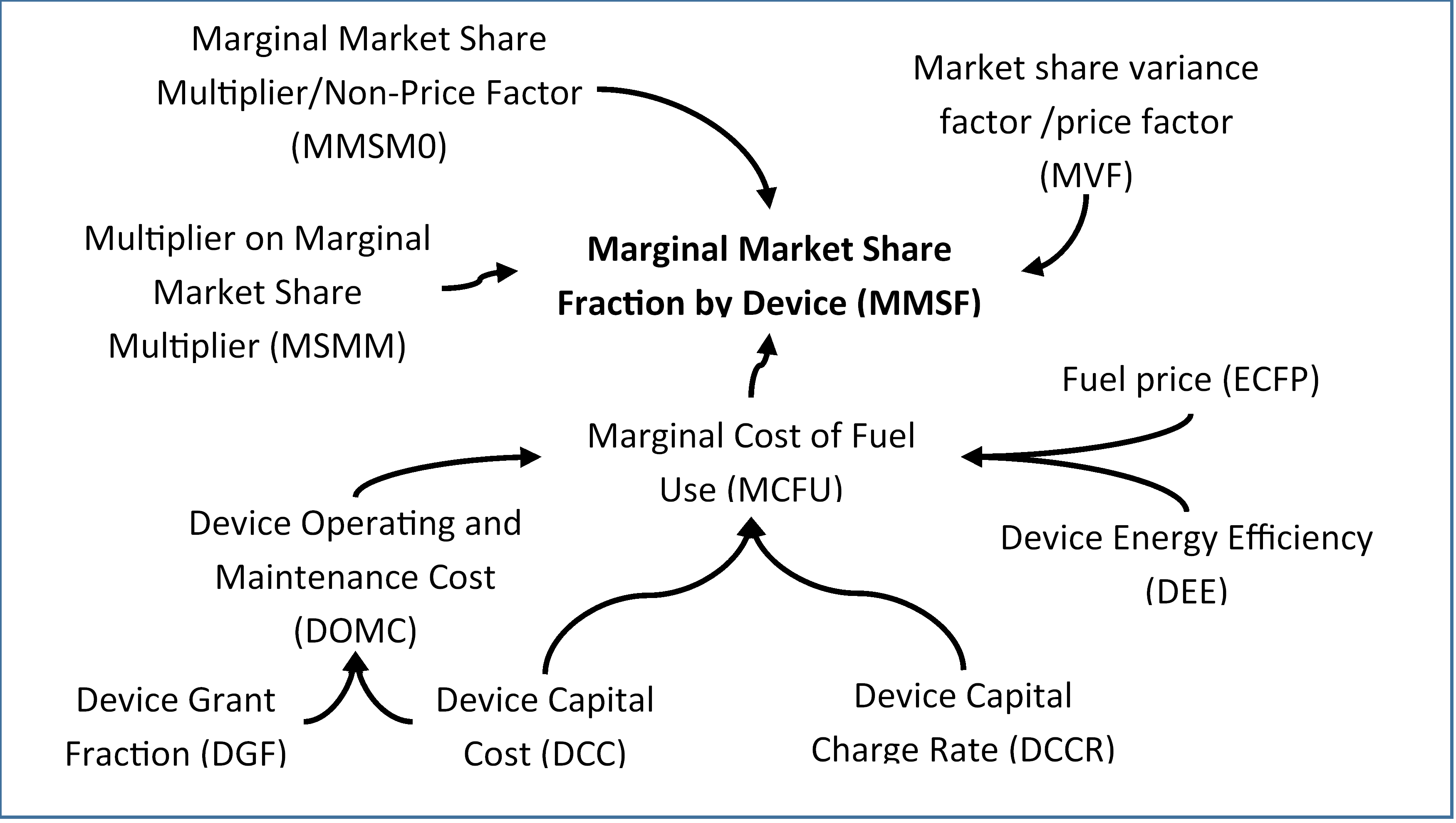
Changes to any of the variables shown in the figure above will impact the marginal market share fraction of fuels. Shifts in fuel shares will occur from shifts in the relative price of fuels (changes in capital costs, efficiency, or fuel prices). Additionally, shifts in fuel shares will occur due to changes in consumers’ non-price factors (propensity toward or resistance to particular fuels). Whereas changes to the values of any of the market share equation input variables will impact the fuel market shares, the variables most commonly used to simulate a fuel switching policy are listed in the table below.
Policy Variables for Fuel Choice Policies
|
Variable Name |
Description |
|
Fuel choice market share (shift consumers’ non-price perceptions) |
|
|
MMSM0(Enduse,Tech,EC,Area,Year) |
Marginal Market Share Multiplier/ Non-Price Factor ($/$). This variable represents the non-price propensity toward or barrier to a specified technology (end use-fuel combination). It is endogenously calculated during the historical calibration and assigned future values to set the marginal equal to the average. Modifying the value of MMSM0 overwrites the endogenously-calculated value assigned during calibration and can be used to promote specific technologies compared to the reference case. |
|
MSMM(Enduse,Tech,EC,Area,Year) |
Multiplier on Marginal Market share Multiplier ($/$). This variable is used as an adjustment multiplier on the marginal market share. Setting a value for this variable can promote specific technologies without directly changing the value of the calculated non-price factor, MMSM0. The default value for this multiplier is 1.0. |
|
Fuel choice (shift relative price of fuels) |
|
|
DGF(Enduse,Tech,EC,Area,Year) |
Domestic Grant Fraction ($/$). The DGF variable is an input to the marginal cost of fuel usage calculation. It is used as a policy variable to assign rebates and price incentives as a means to shifting the market share. Its default value is set to 1.0. |
|
Fuel choice (set an exogenous value fuel market share fraction) |
|
|
XMMSF(Enduse,Tech,EC,Area,Year) |
Exogenous Marginal Market Share Fraction by Device ($/$). If the expected market share needs to be set to a specified value, such as to match an exogenous forecast, an exogenously-specified marginal market share can be assigned. |