
Process Energy Efficiency Model Relationships
Process Energy Efficiency Model Relationships
Consumers choices of efficiency levels, by default, are based on trade-offs between capital costs and efficiency levels and are impacted largely by energy prices.
|
|
🛈 |
Note: Several methods are available to calculate process efficiency. The specific method used is determined based on a switch (PEESw). |
Marginal process efficiency (PEE) is determined by the energy cost (MCFU), the process efficiency curve and the process efficiency multiplier (PEMM). Changes in capital charge rates (PCCRB/PCCR) assume Cobb-Douglas substitution from Capital. The diagram below illustrates the model variables that impact Process Energy Efficiency (PEE).
Inputs to Process Energy (PEE)
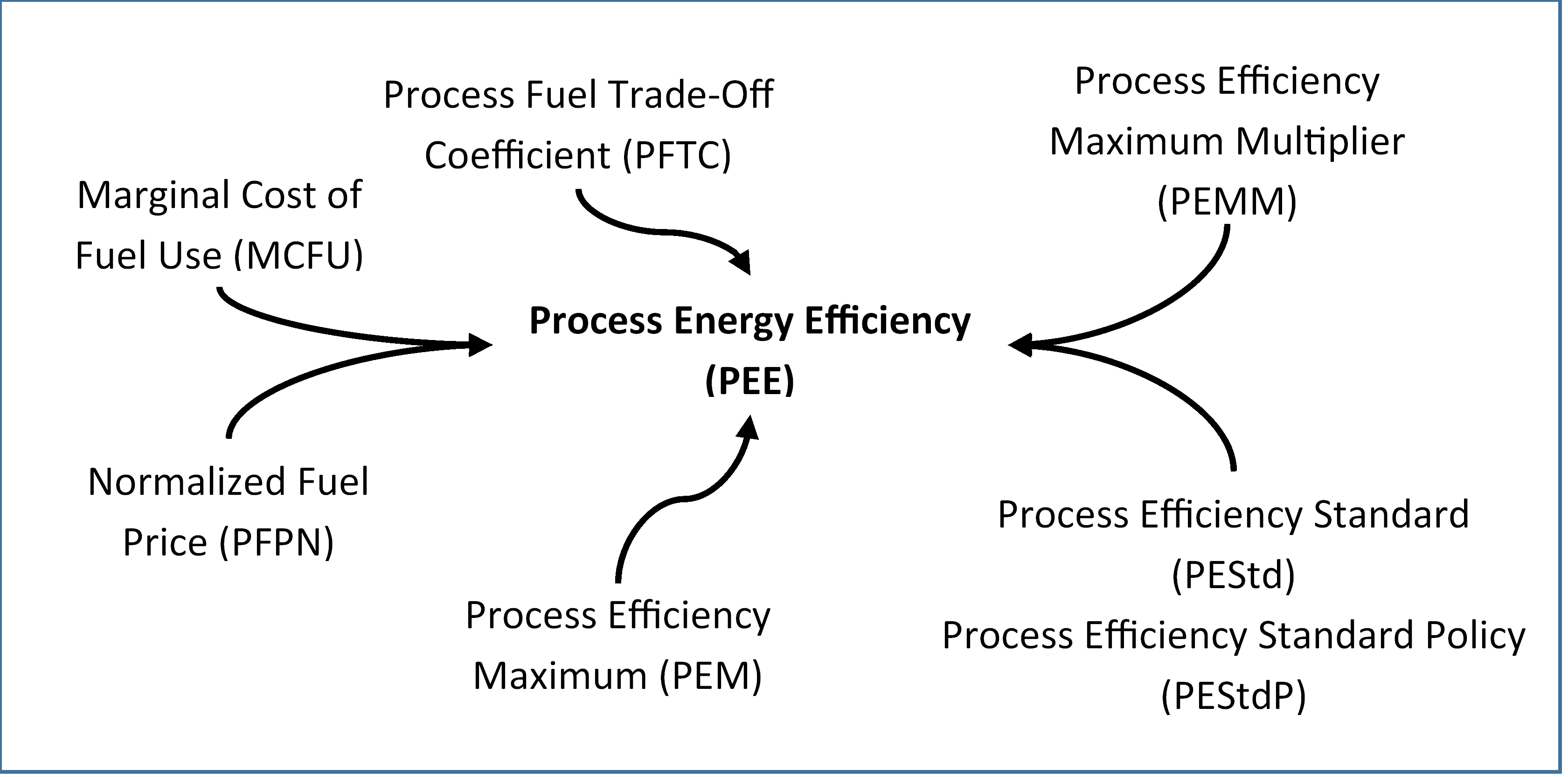
Model Equation for Process Efficiency, PEE (Simplified):
|
PEE = PEM*PEMM*(1/(1+(MCFU/Inflation*PEPM/PFPN)^PFTC*(PCCR/PCCRB))) PEE must not be higher than any standards incorporated or higher than a preassigned process efficiency maximum (PEM) adjusted by the process efficiency multiplier (PEMM). PEE = min(max(PEE,PEStd,PEStdP),PEM*PEMM*0.98) where: PEM[Enduse,Tech,EC,Area] - Maximum Process Efficiency ($/Btu) PEMM[Enduse,Tech,EC,Area,Year] - Process Efficiency Maximum Multiplier ($/Btu/($/Btu)) MCFU[Enduse,Tech,EC,Area,Year] - Marginal Cost of Fuel Use ($/mmBtu) Inflation[Area,Year] - Inflation Index ($/$) PEPM[Enduse,Tech,EC,Area,Year] - Process Energy Price Multiplier ($/$) PFPN[Enduse,Tech,EC,Area] - Process Normalized Fuel Price ($/mmBtu) PFTC[Enduse,Tech,EC,Area,Year] - Process Fuel Trade Off Coefficient PCCR[Enduse,Tech,EC,Area,Year] - Process Capital Charge Rate ($/Yr/$) PCCRB[Enduse,Tech,EC,Area,Year] - Process Capital Charge Rate in Base Case ($/Yr/$) |