
What is ENERGY 2100?
Model Structure
ENERGY 2100 (formerly ENERGY 2020) is an integrated, all-fuel, end-use, energy and emissions mathematical model that simulates the North American energy supply and demand market into the future on an annual basis. The model is used to forecast energy and emissions as well as to perform policy analyses.
The figure below illustrates the overall structural design of ENERGY 2100.
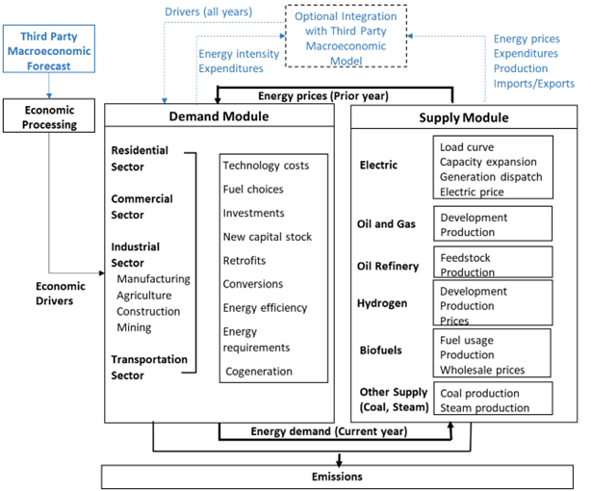
The figure illustrates the high-level model flow with the steps listed below:
- Economic indicators drive energy demand which must be met by energy supplies (local or imports).
- The energy demand module consists of four sectors (residential, commercial, industrial, and transportation). Energy demands are calculated and sent as input to the supply module consisting of six energy producing sectors – electricity, oil and gas, refinery, bio-fuels, coal, and steam.
- The supply module produces the energy required to meet the energy demand, calculates energy prices, and sends energy prices back as feedback to the demand sector.
- Both energy and non-energy related emissions are tracked covering eighteen separate greenhouse gas (GHG) pollutants and criteria air contaminants (CAC) plus water usage.
- ENERGY 2100 is dynamically linked to a macroeconomic model to create a powerful fully integrated energy-emissions-economy modeling system.
In its current configuration, ENERGY 2100 simulates 25 areas - all 14 provinces and territories of Canada, 10 U.S. regions, plus Mexico.
Energy and Emissions Forecasting
The model provides a powerful tool for users to develop long-range forecasts of energy and emissions by detailed fuel types, economic sectors, end uses, and emissions types on an annual basis. Its current configuration allows users to simulate the integrated energy system of North America, including all provinces and territories of Canada, 10 regions of the United States, and Mexico.
Powerful Policy Analysis Capability
ENERGY 2100 provides a powerful capability to simulate a wide variety of policies which impact the energy system across energy demand, energy supply, and emissions. Policies are designed to test impacts of changes made to the energy system in relation to a business-as-usual, or reference case, scenario. Using ENERGY 2100, you are able to simulate policies across each of the residential, commercial, industrial, and transportation demand sectors, electricity, oil, gas, biofuels, hydrogen/ammonia, refineries, and coal supply sectors as well as emissions-related policies crossing both demand and supply sectors.
Examples of some of the policies that can be simulated in ENERGY 2100 are listed in the table below:
|
Policy Category |
Examples |
|
Building & Equipment Policies |
Appliance and building standards, energy efficiency measures |
|
Fuel & Technology Transition Policies |
Fuel-switching incentives, industrial generation incentives |
|
Environmental Regulations |
Clean air standards, vehicle emissions regulations, landfill gas regulations |
|
Carbon Policies |
Carbon taxes, emissions taxes and incentives, cap-and-trade systems |
|
Renewable Energy Policies |
Renewable energy requirements, renewable fuel content standards |
Key Model Outputs
Outputs from ENERGY 2100 include projections of the following concepts given a variety of assumptions, including economic indicators, consumer preferences, characteristics of energy technologies, resource availability and costs, transmission constraints, and the regulatory environment :
- Energy consumption
- Energy efficiency
- Energy investments
- Energy production, imports and exports
- Energy prices
- Emissions across eighteen greenhouse gas pollutants and air pollutants